Representative William Lowndes Yancey
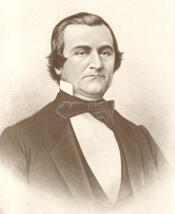
Here you will find contact information for Representative William Lowndes Yancey, including email address, phone number, and mailing address.
| Name | William Lowndes Yancey |
| Position | Representative |
| State | Alabama |
| District | 3 |
| Party | Democratic |
| Status | Former Representative |
| Term Start | December 4, 1843 |
| Term End | March 3, 1847 |
| Terms Served | 2 |
| Born | August 10, 1814 |
| Gender | Male |
| Bioguide ID | Y000003 |
About Representative William Lowndes Yancey
William Lowndes Yancey was a Representative from Alabama in the United States Congress from 1843 to 1847 and later became one of the South’s most prominent advocates of secession. He was born on August 10, 1814, in Warren County, Georgia. After the death of his father, his mother remarried and the family eventually moved to South Carolina, where Yancey spent much of his youth. He attended local academies and read widely, but did not complete a formal college degree. As a young man he worked as a journalist and editor, experiences that helped develop the forceful rhetorical style that later made him a noted public speaker.
Yancey studied law and was admitted to the bar, beginning his legal career in South Carolina before moving west. By the late 1830s he had settled in Alabama, where he quickly entered public life. He served in the Alabama state legislature, gaining a reputation as a populist legislator and firebrand orator. His early political activity aligned him with the Democratic Party, and he became a party leader in the state, advocating strongly for Southern interests and the protection of slavery.
In 1843 Yancey was elected as a Democrat to the United States House of Representatives from Alabama. He served two terms in Congress, participating in the legislative process during a significant period in American history marked by debates over territorial expansion and the future of slavery. As a member of the House of Representatives, he represented the interests of his Alabama constituents and took part in the broader national discussion over states’ rights and sectional power. Yancey resigned his seat on September 1, 1846, before the completion of his second term, in part because he believed he could more effectively advance Southern positions outside the constraints of national office.
Following his resignation from Congress, Yancey returned to Alabama and joined with John A. Elmore to form a legal firm in Montgomery. Their practice was housed in what became known as the William Lowndes Yancey Law Office, located at the corner of Washington and Perry Streets in Montgomery, Alabama. Yancey maintained his law office in this building from 1846 until his death in 1863. While the structure later became closely associated with his name, it was designated historic primarily because it had served as the Post Office of the Confederate States of America, as indicated by a plaque on the building, rather than because of its use as Yancey’s office.
In the 1850s Yancey emerged as one of the leading Southern “Fire-Eaters,” a group of radical pro-slavery politicians who pressed for aggressive defense of slavery and states’ rights. As a lawyer, populist legislator, firebrand orator, and party leader, he became an important figure in sectional politics in the years leading up to the Civil War. He gained national influence as an outspoken advocate of slavery and states’ rights and played a significant role in exacerbating sectional tensions between North and South. His speeches and political maneuvering helped push Southern opinion toward secession, and he was instrumental in shaping the rhetoric that framed disunion as a necessary response to perceived Northern aggression.
After the election of Abraham Lincoln in 1860, Yancey took a direct role in the secession movement. He wrote Alabama’s Ordinance of Secession, the formal document by which the state withdrew from the Union in January 1861. With the formation of the Confederate States of America, Yancey was selected to represent the new government abroad. He served as the Confederacy’s Commissioner to England and France, seeking diplomatic recognition and support for the Confederate cause. Although he was a skilled orator, his mission did not achieve formal recognition of the Confederacy by the major European powers, but it underscored his prominence within the Confederate leadership.
Yancey’s later years were marked by declining health, though he remained an influential voice in Confederate politics and public life until his death. He died on July 27, 1863, in Montgomery, Alabama. The law office where he had practiced from 1846 until his death continued to stand as a reminder of his controversial role in American history. The building was listed on the National Register of Historic Places in 1973 and was also declared a National Historic Landmark on November 7, 1973. At the time of its landmark designation, the interior retained its historic floor plan and decorative details. However, redevelopment of the site in the late 1970s led to alterations that caused substantial loss of historic elements, and the National Historic Landmark designation was withdrawn on March 5, 1986. Despite this, the building remains on the National Register of Historic Places, reflecting both its association with the Confederate postal service and its long use as the office of William Lowndes Yancey, a central figure in the sectional conflicts that culminated in the Civil War.