Representative Williamson Robert Winfield Cobb
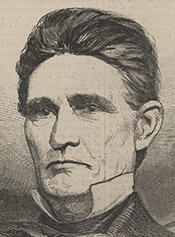
Here you will find contact information for Representative Williamson Robert Winfield Cobb, including email address, phone number, and mailing address.
| Name | Williamson Robert Winfield Cobb |
| Position | Representative |
| State | Alabama |
| District | 6 |
| Party | Democratic |
| Status | Former Representative |
| Term Start | December 6, 1847 |
| Term End | March 3, 1861 |
| Terms Served | 7 |
| Born | June 8, 1807 |
| Gender | Male |
| Bioguide ID | C000554 |
About Representative Williamson Robert Winfield Cobb
Williamson Robert Winfield Cobb (June 8, 1807 – November 1, 1864) was an American politician who served the state of Alabama in the U.S. House of Representatives between 1847 and 1861. A member of the Democratic Party, he represented Alabama in the United States Congress for seven consecutive terms during a significant period in American history, contributing to the legislative process and participating in the democratic governance of the nation on the eve of the Civil War.
Cobb was born in Rhea County, Tennessee, on June 8, 1807, to David Cobb and Martha Bryant. In 1809 he moved with his father to Bellefonte in Jackson County, Alabama, a frontier region that would remain his home for most of his life. His formal schooling was limited, and he did not enjoy the advantages of higher education that many of his later political rivals possessed. As a young man he worked as a clock peddler and later as a merchant in Bellefonte, occupations that brought him into close contact with the small farmers and tradespeople of northeastern Alabama and helped shape his political identity as a representative of the “plain folk” of the hill country.
Cobb’s political career began in state politics. Building on his local reputation as a merchant and advocate for ordinary citizens, he was elected to the Alabama House of Representatives in 1844. His service in the state legislature established him as a Democrat aligned with the interests of less affluent constituents in the mountainous counties of northeast Alabama. In 1846 he was elected as a Democrat to the U.S. House of Representatives from Alabama’s sixth congressional district, which at that time included Huntsville and the surrounding hill country, including his home county of Jackson, carved out of Madison County in 1819.
From 1847 to 1861, Cobb served seven terms in the U.S. House of Representatives, consistently winning reelection against more affluent and better educated opponents, often from the more urban and prosperous community of Huntsville. Among those he defeated was Clement Claiborne Clay, a prominent Alabama politician. Although he himself owned slaves, Cobb ran on an anti-elite platform that resonated strongly with poorer and disenfranchised white voters in the hill country, who saw in him a defender of their interests against the planter and commercial elites. During his fourteen years in Congress, he participated actively in the legislative process and represented the concerns of his constituents during a period marked by sectional conflict, debates over slavery and territorial expansion, and the mounting tensions that would culminate in the Civil War.
Cobb was notable for his strong Unionist views and his opposition to secession, positions that set him apart from many of his fellow Southern Democrats as the crisis of the Union deepened. When Alabama seceded from the Union in 1861, he withdrew from the U.S. Congress only reluctantly, reflecting his continued attachment to the Union even as his state left it. After secession, he sought to continue his political career within the new Confederate government. He ran unsuccessfully for the Confederate House of Representatives in 1861 but was later elected to the Second Confederate Congress in 1863, at a time when antiwar and anti-administration sentiment was growing in parts of the Confederacy, including regions like his own that had long harbored Unionist sympathies.
Despite his election to the Second Confederate Congress, Cobb did not appear in Richmond to take his seat. His absence, coupled with his openly avowed Unionist sentiments and his presence “behind enemy lines on terms of friendly intercourse,” led to formal proceedings against him. On May 3, 1864, the Confederate House of Representatives created a committee of five members to investigate charges against Cobb. After his death, the House voted 75 to 0 on November 17, 1864, in favor of expelling him from the Confederate Congress. The resolution appears to have been adopted without knowledge of, or even in spite of, Cobb’s demise, and charged him with failing to claim his seat, maintaining friendly relations within Union-held territory, and “manifesting his disloyalty to the Confederate States.”
Cobb’s life ended abruptly and accidentally during the final year of the Civil War. On November 1, 1864, he was killed by the accidental discharge of his own pistol while he was putting up a fence on his plantation near Bellefonte, in Jackson County, Alabama. He was buried in the family cemetery on the estate of his brother, Bryant Anderson Cobb, in neighboring Madison County. His career, spanning service in the Alabama House of Representatives, seven terms in the U.S. House of Representatives, and a contested election to the Confederate Congress, reflected both the opportunities available to a self-made politician in the antebellum South and the deep political and sectional divisions that marked the era in which he lived.