Senator Winston Prouty
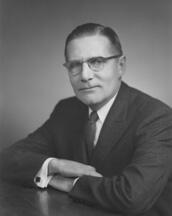
Here you will find contact information for Senator Winston Prouty, including email address, phone number, and mailing address.
| Name | Winston Prouty |
| Position | Senator |
| State | Vermont |
| Party | Republican |
| Status | Former Representative |
| Term Start | January 3, 1951 |
| Term End | January 3, 1971 |
| Terms Served | 11 |
| Born | September 1, 1906 |
| Gender | Male |
| Bioguide ID | P000552 |
About Senator Winston Prouty
Winston Lewis Prouty (September 1, 1906 – September 10, 1971) was an American banker and Republican politician who represented Vermont in the United States House of Representatives from 1951 to 1959 and the United States Senate from 1959 until his death in 1971. Over the course of six terms in Congress, he contributed to the legislative process during a significant period in American history, participating in the democratic process and representing the interests of his Vermont constituents. Before his service in Congress, he was mayor of Newport, a member of the Vermont House of Representatives, and Speaker of the Vermont House from 1947 to 1949.
Prouty was born in Newport, Vermont, to Willard Robert and Margaret (née Lockhart) Prouty. His family owned Prouty & Miller Lumber Company, a lumber and building materials business that played a central role in the local economy. Politics was a longstanding family vocation: his father and grandfather both served as state legislators, his uncle Charles A. Prouty was a member of the Interstate Commerce Commission, and another uncle, George H. Prouty, served as Governor of Vermont from 1908 to 1910. Growing up in this environment, Prouty was exposed early to both business and public service, influences that would shape his later career.
Prouty received his early education in the public schools of Newport and then attended St. Paul’s School in Garden City, New York, followed by Bordentown Military Institute in New Jersey. He went on to study engineering at Lafayette College in Easton, Pennsylvania, from 1925 to 1927, and during his time there he became a member of the Delta Upsilon fraternity. Although he did not complete a degree, his technical studies and collegiate experience informed his later interest in infrastructure, industry, and economic development. In recognition of his public service, Lafayette College awarded him the honorary degree of Doctor of Laws (LL.D.) in 1966.
After leaving Lafayette, Prouty returned to Newport and joined his family’s firm, Prouty & Miller. In addition to his work in the lumber and building materials business, he became a director of the National Bank of Newport and of Associated Industries of Vermont, establishing himself as a banker and business leader. Despite being described as shy and reticent—due in part to self-consciousness over the loss of his right thumb in an accident at the family business—he decided to pursue a career in politics. A Republican, he was elected to the Newport City Council, serving from 1933 to 1937, and then as mayor of Newport from 1938 to 1941. He entered state politics with his election to the Vermont House of Representatives in 1940, serving from 1941 to 1949. In his final two years in the legislature, from 1947 to 1949, he was elected Speaker of the Vermont House. He sought higher state office in 1948 as a candidate for the Republican nomination for lieutenant governor, but was unsuccessful, losing to Harold J. Arthur. From 1949 to 1950, he served as chairman of the Vermont Water Conservation Board, reflecting his growing engagement with statewide policy issues.
Prouty’s congressional career began after longtime incumbent Charles Albert Plumley decided not to seek reelection in 1950. Prouty announced his candidacy for Vermont’s at-large seat in the United States House of Representatives and won the Republican nomination in a four-way primary that included Governor Harold J. Arthur. In the general election he defeated Democrat Herbert B. Comings by a margin of 73 percent to 26 percent. He was subsequently reelected to three additional terms, never receiving less than 61 percent of the vote. During his tenure in the House, which lasted from January 3, 1951, to January 3, 1959, he served on the Committee on Veterans’ Affairs and the House Committee on Foreign Affairs. He was an advocate for the creation of the Saint Lawrence Seaway, viewing it as vital to regional and national commerce. In keeping with his later civil rights record, he voted in favor of the Civil Rights Act of 1957, aligning himself with bipartisan efforts to advance federal civil rights protections.
In 1958, Prouty successfully ran for the United States Senate, beginning his service there on January 3, 1959. He was reelected in 1964 and 1970 and served until his death in 1971. In the Senate, he held assignments on several key committees, including the Committee on the District of Columbia, the Committee on Rules and Administration, the Committee on Labor and Public Welfare, and the Committee on Commerce, as well as the Special Committee on Aging and the Select Committee on Small Business. He became particularly identified with issues such as federal aid for school construction, federal funding for courses for students with special needs, and the promotion of arts and music education. He was also an advocate for the needs of senior citizens, supporting expanded health care provisions and the broadening of Social Security eligibility. A longtime proponent of improved transportation, he worked to restore passenger rail service to Vermont. As the ranking Republican on the District of Columbia Committee, he sponsored the legislation that created the position of Delegate to Congress for the District of Columbia, giving residents a formal, though nonvoting, representative in the House.
Prouty’s Senate record on civil rights and voting rights was notable for its consistency. During his tenure in the Senate, he voted in favor of the Civil Rights Acts of 1960, 1964, and 1968, supported the 24th Amendment to the United States Constitution prohibiting poll taxes in federal elections, and backed the Voting Rights Act of 1965. He also voted to confirm Thurgood Marshall as the first African American justice of the United States Supreme Court. These votes placed him among the Republicans who supported the major civil rights and voting rights measures of the mid-twentieth century, reflecting both his party’s historic role in civil rights and his own commitment to equal protection under the law.
In his personal life, Prouty married Frances Currie Hearle Backus (1907–1960) of Stanstead, Quebec, in 1939. She was the mother of three daughters—Currie, Elizabeth, and Ann—from a previous marriage, and Prouty became stepfather to the children. After Frances Prouty’s death in 1960, he married Jennette Herbert Hall (1913–2002) in 1962. Hall had been the chief aide to Representatives Henry J. Latham of New York and Robert E. Cook of Ohio, and her own experience on Capitol Hill complemented Prouty’s congressional career. Their marriage continued through the final decade of his life.
Winston Lewis Prouty died from complications of gastric cancer at New England Deaconess Hospital in Boston, Massachusetts, on September 10, 1971, while still serving in the United States Senate. His death placed him among the members of Congress who died in office in the period from 1950 to 1999. He was buried in Pine Grove Cemetery in Newport, Vermont, returning to the community where he had been born, educated, begun his business career, and first entered public life.