Senator Zachariah Chandler
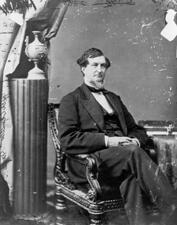
Here you will find contact information for Senator Zachariah Chandler, including email address, phone number, and mailing address.
| Name | Zachariah Chandler |
| Position | Senator |
| State | Michigan |
| Party | Republican |
| Status | Former Representative |
| Term Start | December 7, 1857 |
| Term End | December 31, 1879 |
| Terms Served | 4 |
| Born | December 10, 1813 |
| Gender | Male |
| Bioguide ID | C000299 |
About Senator Zachariah Chandler
Zachariah Chandler (December 10, 1813 – November 1, 1879) was an American businessman, politician, and one of the founders of the Republican Party, whose radical wing he dominated as a lifelong abolitionist. A leading figure in mid‑nineteenth‑century national politics, he served as mayor of Detroit, a four‑term United States senator from Michigan, and Secretary of the Interior under President Ulysses S. Grant. A member of the Republican Party throughout his congressional career, Chandler represented Michigan in the United States Senate from 1857 to 1879, contributing to the legislative process during four terms in office and playing a prominent role in the politics of the Civil War and Reconstruction eras.
Chandler was born in Bedford, New Hampshire, on December 10, 1813, the son of Samuel Chandler and Margaret Orr. Through his father, he was a descendant of William Chandler, who had migrated from England to Roxbury, Massachusetts, in 1637, making Zachariah the seventh generation of his family born in North America. His mother, Margaret, was the eldest daughter of Col. John Orr, a military officer. Chandler was educated in the common schools of New Hampshire. Choosing not to attend college, he decided instead to seek opportunity in the West. In 1833 he moved to Detroit, then the capital of Michigan Territory, where he opened a general store. Through trade, banking, and land speculation, he became one of the wealthiest men in Michigan, establishing the financial base that would support his later political career and his abolitionist activities.
On December 10, 1844, Chandler married Letitia Grace Douglas, a native of Baltimore who had moved to New York. Letitia became known as a gracious social entertainer and spent winters in Washington, D.C., throughout Chandler’s political career. The couple had one daughter, Mary Douglas Chandler, who married Eugene Hale, later a United States senator from Maine. Their grandchildren included Frederick Hale, a long‑serving U.S. senator from Maine, and Chandler Hale, who served as a U.S. diplomat in Rome. Letitia, described as having a gentle and kindly disposition and being much beloved, survived her husband by two decades and died on February 19, 1899. From his youth Chandler had been strongly opposed to slavery, and as a prosperous young businessman in Detroit he financially supported the Underground Railroad, aiding fugitive enslaved people seeking freedom in the North.
Chandler’s formal political career began in the late 1840s. Initially a Whig, he hoped that the Northern Whig Party would halt the expansion of slavery into the western territories. In 1848 he entered politics by making campaign speeches for Whig presidential candidate Zachary Taylor. In 1851 he was elected mayor of Detroit, serving one year in office. The following year he ran as the Whig candidate for governor of Michigan but was defeated. As the national crisis over slavery deepened, Chandler became an early and active organizer of the emerging Republican Party. He supported the admission of Kansas as a free state and, on July 6, 1854, signed a petition that helped to form the Republican Party in Michigan. In 1856 he served as a delegate to the first Republican National Convention in Pittsburgh, Pennsylvania, and became a member of the Republican National Committee. That convention nominated John C. Frémont for president, a candidate who opposed the extension of slavery into Kansas and the repeal of the Missouri Compromise.
In January 1857 Chandler was elected as a Republican to the United States Senate from Michigan, succeeding Lewis Cass. He served from March 4, 1857, to March 3, 1875, in the 35th through the 43rd Congresses, and was reelected in 1863 and 1869. A staunch opponent of slavery and secession, he aligned himself with the Radical Republicans in the Senate, although he often clashed with fellow Radical Charles Sumner of Massachusetts. Chandler was widely regarded as the most outspoken senator against secession on the eve of the Civil War. From March 1861 to 1875 he chaired the powerful Committee on Commerce, which oversaw substantial appropriations for rivers and harbors and gave him significant influence over federal spending. At the outbreak of the Civil War, he used his position to help raise and equip Michigan volunteers for the Union Army and served on the Joint Committee on the Conduct of the War, which investigated and criticized Union military leadership.
During the war Chandler emerged as a fierce critic of General George B. McClellan’s cautious strategy. In a widely noted speech at Jackson, Michigan, on July 6, 1862, delivered just days after McClellan’s failure to capture Richmond and his withdrawal to the James River during the Seven Days Battles, Chandler castigated the general’s prosecution of the war; he later regarded this address as one of his most important public services. In Congress he authored significant wartime legislation, including the act of March 3, 1863, providing for the collection and administration of abandoned property in the South, and the act of July 2, 1864, regulating commercial intercourse with the insurrectionist Confederate states. He supported higher tariff rates, the creation of a national banking system, and the issuance of greenbacks as an emergency war measure, while strongly opposing inflationary policies. Chandler was also an ardent advocate of civil rights for African Americans and backed Reconstruction Acts that extended legal protections and political rights to freedpeople, though he criticized Reconstruction policy as too lenient toward former Confederates. He was known for his caustic partisanship, once declaring after the war that “Every man who murdered and stole and poisoned was a Democrat.”
Chandler’s foreign policy positions reflected his nationalism and his anger at British support for the Confederacy. On January 5, 1866, he introduced a resolution calling for non‑intercourse with Great Britain because of its refusal to negotiate the Alabama Claims, arising from British‑built Confederate commerce raiders such as the CSS Alabama that had inflicted heavy damage on Union shipping. On November 29, 1867, in a symbolic act of retaliation, he submitted a resolution urging that Abyssinia (Ethiopia) be recognized as a belligerent nation at war with Great Britain, demanding that it be accorded the same rights Britain had extended to the Confederacy during the Civil War. Domestically, Chandler used federal patronage aggressively to consolidate his control over the Republican organization in Michigan. His methods were widely viewed as openly partisan and, in the eyes of critics, despotic if not actually corrupt. For many years he was the undisputed Republican boss in Michigan. He also played a national role in party politics, serving as chairman of the Republican Congressional Committee during the 1868 election.
The Democratic landslide in the 1874 elections weakened Republican control in Michigan and broke Chandler’s long‑standing senatorial dominance. Seeking election to a fourth consecutive term, he was defeated in the state legislature by Isaac P. Christiancy after a protracted deadlock, and his initial Senate service ended on March 3, 1875. Later that year, in October 1875, President Ulysses S. Grant appointed him Secretary of the Interior. Chandler served in the Cabinet until 1877, undertaking an aggressive program of reform and reorganization in a department that had become notorious for corruption under his predecessor, Columbus Delano. He fully endorsed Grant’s Peace Policy toward Native American tribes, which aimed at their “civilization” under federal supervision, and sought to eliminate abuses that had flourished in the Bureau of Indian Affairs and other Interior bureaus.
As Secretary of the Interior, Chandler found the Bureau of Indian Affairs to be, in his view, the most corrupt office under his jurisdiction. He replaced the commissioner and chief clerk and quietly investigated the bureau, uncovering widespread profiteering and questionable practices. When the new commissioner resisted the removal of corrupt subordinates as indispensable to operations, Chandler initially delayed but, after President Grant personally ordered that the clerks be dismissed even at the risk of shutting down the bureau, he immediately complied and had them fired. This episode marked one of the few occasions when Grant intervened directly in departmental reform, and he continued to back Chandler’s efforts. Chandler also banned “Indian Attorneys” from the Interior Department in December 1875—self‑styled agents who extracted substantial fees and land concessions from tribes in exchange for dubious representation in Washington. Declaring their claims illegal and immoral, he insisted that the regular Indian agents, the Commissioner of Indian Affairs, and the Secretary of the Interior were fully competent to protect tribal rights, a policy that saved Native communities considerable sums. In February 1876 he turned over to Secretary of War William W. Belknap responsibility for dealing with Native groups who refused to leave their hunting grounds in the Black Hills amid encroaching miners, reflecting the growing militarization of Indian policy in that region.
Chandler extended his reform campaign to other Interior bureaus. He ordered a thorough investigation of the Pension Bureau, resulting in the removal of fraudulent claims and saving the federal government hundreds of thousands of dollars; within a month he dismissed all clerks implicated in corruption. He directed Charles T. Gorham, whom he persuaded Grant to appoint Assistant Secretary of the Interior, and Augustus S. Gaylord, named Assistant Attorney General for the department, to investigate the General Land Office. Their inquiry uncovered a “Chippewa half‑breed scrip” profiteering ring, which Chandler broke up by firing all officials involved. At the Patent Office, he took the extraordinary step of dismissing every clerk in one room, declaring all desks vacant on the belief that the entire group was either corrupt or unfit for reform. He locked the room under the supervision of an African American porter until trustworthy replacements could be found, and he ignored complaints from those who claimed unjust dismissal, warning at least one not to appeal to the press. A surprise investigation of payroll procedures revealed nearly twenty fictitious employees whose names had been used to siphon off government funds; Chandler removed those responsible and also eliminated unqualified clerks who profited by hiring out their work to underpaid substitutes. He simplified patent rules, making patents easier and less costly to obtain for the public.
After leaving the Cabinet in 1877—President Rutherford B. Hayes, whose 1876 presidential campaign Chandler had managed as chairman of the Republican National Committee, chose not to retain him as Interior Secretary—Chandler remained active in party politics. He became chairman of the Michigan Republican Party in 1878 and worked to rebuild his influence in state and national affairs. In 1879 he was again elected to the United States Senate from Michigan, returning to the chamber where he had been a central figure during the Civil War and Reconstruction. At the time of his reelection he was regarded as a potential Republican presidential candidate. On October 31, 1879, he delivered a political speech in Chicago, Illinois, but in the early hours of November 1, 1879, he died suddenly in his room at the Grand Pacific Hotel in Chicago, bringing an abrupt end to his renewed Senate career and national ambitions.
Chandler’s public life spanned the formative decades of the Republican Party and the nation’s struggle over slavery, union, and civil rights. A lifelong abolitionist and Radical Republican, he advocated vigorously for the Union war effort, the abolition of slavery, and civil rights for freed African Americans, while also supporting high tariffs, a national banking system, and a stable currency. His legacy extended into later generations of public service: his great‑great grandnephew Rod Chandler served as a Republican member of the U.S. House of Representatives from Washington State from 1983 to 1993.