Representative Zadock Pratt
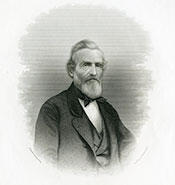
Here you will find contact information for Representative Zadock Pratt, including email address, phone number, and mailing address.
| Name | Zadock Pratt |
| Position | Representative |
| State | New York |
| District | 11 |
| Party | Democratic |
| Status | Former Representative |
| Term Start | September 4, 1837 |
| Term End | March 3, 1845 |
| Terms Served | 2 |
| Born | October 30, 1790 |
| Gender | Male |
| Bioguide ID | P000507 |
About Representative Zadock Pratt
Zadock Pratt Jr. (October 30, 1790 – April 5, 1871) was an American tanner, banker, soldier, and Democratic member of the United States House of Representatives from New York, serving two non-consecutive terms in the mid-nineteenth century. He represented New York in Congress from 1837 to 1845, contributing to the legislative process during a significant period in American history, and was noted in particular for his advocacy of reduced postage rates and internal improvements.
Pratt was born on October 30, 1790, in Stephentown, New York, to Hannah (Pickett) Pratt and Zadock Pratt Sr., the fifth of seven children. In 1797 he moved with his family to Middleburgh, New York, and in 1802, at age twelve, he moved again with his parents to Windham, New York, a community that soon became Lexington and is in present-day Jewett. His formal education was limited to intermittent attendance at public school; much of his youth was spent working on his father’s farm and in his father’s small tannery, which consisted of two limes and eight vats, with bark ground by a circular millstone driven by horse power. In 1810, at age twenty, he became an apprentice to Luther Hayes, a saddler in Durham. After completing his apprenticeship, he worked for a year as a traveling saddler, saving $100, and in 1812 he returned to Lexington, where he continued as a saddler, often working fourteen-hour days. In 1814 he built a general store in what would become Prattsville, bartering with local residents for goods and making periodic trips to New York City to trade those goods.
Pratt’s early adulthood combined military service, commercial enterprise, and the beginnings of his career in tanning. He volunteered for service in the War of 1812 in 1814 and served as steward of a company stationed at Brooklyn Heights. For arms and clothing destroyed during the war he later received $11 in compensation, and in 1857 he was granted a warrant for 160 acres of land for his wartime service. After the war ended in 1815, he returned to Lexington and sold his store. On May 7, 1817, he entered the tanning business with his older brother Ezra and younger brother Bennett. On October 18, 1818, he married Beda Dickerman of Hamden, Connecticut; she died of tuberculosis six months later, on April 19, 1819. Shortly thereafter, Pratt and Ezra bought out Bennett’s share of the tannery for $2,200. On April 25, 1820, Pratt was chosen captain of the Fifth Regiment of New York State Artillery, a unit of 130 men, and he secured for the regiment a cannon that had been used at the Battle of Plattsburgh. He was appointed a magistrate of Lexington in 1821. In 1823 he married Esther Dickerman, sister of his first wife; she also died of tuberculosis on April 22, 1824, less than a year after their marriage.
The death of his second wife coincided with Pratt’s decision to embark on a much larger tanning enterprise. Dissolving his partnership with his brother, and armed with $14,000 in capital, he spent the summer of 1824 exploring surrounding counties with his dog in search of a site for a major tannery. He chose a location in the western part of Windham, in what is now Prattsville, attracted by its extensive hemlock forests, essential for tanning, and its proximity to Schoharie Creek. On October 24, 1824, he moved his belongings to the site and purchased a large meadow for $1,300; the next day he broke ground on the tannery and soon dammed the creek with the help of laborers. The resulting establishment was one of the largest tanneries of its time, measuring 550 feet in length and 43 feet in width, with 350 vats, six heaters, twelve leaches, two bark mills driven by a great wheel, and three hide mills. His foreman, Osmer B. Wheeler, later founded his own tannery in Forestburgh, New York, and became a member of the New York State Senate. The Prattsville Commercial Building, associated with the town’s early commercial development around this enterprise and built about 1824, was later listed on the National Register of Historic Places in 1996. Pratt financed multiple smaller tanneries in the Catskills and also one in Pennsylvania as a joint venture with future railroad magnate Jay Gould, further extending his influence in the leather industry.
Pratt’s military and civic responsibilities grew alongside his business interests. On July 12, 1822, he became colonel of New York’s 116th Infantry Regiment, a position he held until his resignation from the New York militia on September 4, 1826; in 1825 he commanded the escort of the Marquis de Lafayette into Catskill during Lafayette’s celebrated tour of the United States. On October 12, 1827, Pratt married his third wife, Abigail P. Watson of Rensselaer County. They had a son, George W. Pratt (1830–1862), who later served as a New York State senator and as a Union officer in the Civil War. On November 20, 1832, Zadock Pratt applied to the New York State Legislature to divide the town of Windham, and on March 8, 1833, the town of Prattsville was created from Windham, with a population of about 1,500. His daughter Abigail was born on January 26, 1834; Abigail Watson Pratt died ten days later, on February 5, 1834, at age twenty-six. On March 16, 1835, he married his fourth wife, Mary E. Watson, sister of his third wife; she died in Providence, New York, on July 17, 1868. In addition to his tanning and civic activities, Pratt became involved in banking and local development, and he offered to endow Prattsville Academy with $5,000 if the sum were matched by a Christian church. He later donated the land for the academy and provided half of the building costs.
Pratt entered national politics as a Democrat in the 1830s. In 1836 he secured the Democratic nomination for New York’s 8th congressional district and won the general election by just under 3,000 votes. He served in the U.S. House of Representatives from 1837 to 1839 in the Twenty-fifth Congress. On September 10, 1837, he was appointed to the Committee on the Militia, and on December 11, 1837, he was appointed to the Committee on Public Buildings. During this first term he never missed a session. On March 19, 1838, he introduced a bill to drastically reduce postage rates, arguing that high postage costs disproportionately burdened the poor and functioned as a tax on intelligence by impeding the free circulation of information. The bill passed, reducing the cost of postage from twenty-five cents to five cents, and he was so proud of this achievement that he later had inscribed on his gravestone: “WHILE MEMBER OF CONGRESS; MOVED THE REDUCTION OF POSTAGE; A.D. 1838.” On February 25, 1839, he urged that federal public buildings no longer be constructed of sandstone, which absorbed water and required extensive maintenance, but instead of marble or granite, noting that marble, when building costs were considered, was cheaper than granite. He also advocated constructing a dry dock in Brooklyn rather than Philadelphia and supported the establishment of a branch mint in New York City. On July 4, 1838, despite strong encouragement from his constituents to continue, he publicly declined to run for re-election, and he left Congress at the end of his term.
Although Pratt initially did not intend to return to Congress, he accepted the Democratic nomination again in 1842 and was elected to represent New York’s 11th congressional district, serving in the Twenty-eighth Congress from 1843 to 1845. During his second term he continued to press for legislation promoting infrastructure, financial efficiency, and national development. He advocated the creation of what would become the Bureau of Engraving and Printing to improve the production and security of federal paper currency and other government documents. He renewed his call for public buildings in Washington, D.C., to be constructed of marble or granite rather than sandstone, and he supported the construction of a dry dock in Brooklyn to strengthen the nation’s naval capabilities. In 1844 he initiated the first congressional survey for a transcontinental railroad to the Pacific, an early step in the long process that would eventually lead to the completion of a railroad linking the Atlantic and Pacific coasts. His gravestone later commemorated this effort with the inscription that he “MOVED … THE SURVEY FOR A RAILROAD TO THE PACIFIC A.D. 1844.” While in Congress he also began a movement to complete the Washington Monument and started the practice of hanging presidential portraits in the Rotunda of the United States Capitol. Throughout his two non-consecutive terms, from 1837 to 1839 and again from 1843 to 1845, he was recognized as an active Democratic representative who participated fully in the legislative process and represented the interests of his New York constituents during a transformative era in American politics.
In his later years, Pratt remained a prominent figure in New York’s economic and political life. He continued to operate and finance tanneries in the Catskills and Pennsylvania, and he was involved in banking and local improvements in Prattsville and the surrounding region. In 1839 he suffered a significant setback when the Westkill Lexington tannery burned, causing a loss of $10,000, of which only $7,000 was covered by insurance, but he remained a leading industrialist. He founded the Prattsville Advocate newspaper in 1842, with J. L. Hackstaff as editor, to promote local interests and public discourse. That same year the Prattsville Academy was built, reflecting his longstanding commitment to education. In 1848 he received an honorary Master of Arts degree from Union College, recognizing his contributions to industry and public service. In 1852 he served as a delegate to the Democratic National Convention, maintaining his influence within the party. Pratt died on April 5, 1871, leaving a legacy as a self-made industrialist, militia officer, civic leader, and congressman whose initiatives in postal reform, public architecture, and internal improvements were remembered both in public records and on his own epitaph.